
The Position
TNM Education holds that Texas is a nation. The claim is about the present. Texas was a nation before it was a state, and it remains one. The Texas Nationalist Movement states it as the first of its Twelve Principles: "Texas is a nation with a distinct culture, economy, and government."
A vote does not make Texas a nation. The nation already exists. A vote would decide what Texas does next.
Nation, State, and Country
The argument turns on three words that mean three different things. Daniel Miller, president of the Texas Nationalist Movement, sets them side by side in his essay Nation, State, and Country: "Nation, the people. State, the sovereignty. Country, the land."
A nation is a people conscious of itself as a people. The modern definition comes from Ernest Renan's 1882 lecture at the Sorbonne, "What Is a Nation?" Renan tested the usual answers, race, language, religion, and geography, and found that none of them makes a nation by itself. A nation, he said, rests on a shared inheritance of memories and on the present will to live together and carry that inheritance forward. He called its existence "a daily plebiscite." He meant consent renewed in ordinary life, every day, not a single election.
That consent is civic. Hans Kohn distinguished a nationalism built on descent from one a person joins by taking up a people's history and loyalties. Texas is the second kind. Anglo and Tejano, German and Czech, and every wave of newcomers since became one people by becoming Texian.
A state is a people organized as a sovereign power. The Montevideo Convention of 1933 lists its qualifications: "a permanent population," "a defined territory," a government, and the "capacity to enter into relations with the other states." Article 3 adds that "the political existence of the state is independent of recognition by the other states." Statehood is a fact, and recognition acknowledges it. The United States is a party to the convention.
A country is the land, the homeland a people knows as its own. No one disputes that Texas is one.
In Texas the three meet. Its people have a shared memory and keep it on purpose. It has a population of more than 31 million (see The Texas Economy in Official Numbers), settled borders, and a constitutional government that has never stopped operating. It conducted its own foreign relations for nearly a decade as a republic, covered in The Republic Among Nations. Its constitution still calls it "a free and independent State."
Miller's 2011 book Line in the Sand measures a claim of nationhood against six marks: recognition by the people themselves, recognition by others, a distinct culture, a distinct history, a distinct economic philosophy, and a distinct political philosophy. The record below takes up history, culture, and the symbols Texans keep.
The Founding Record
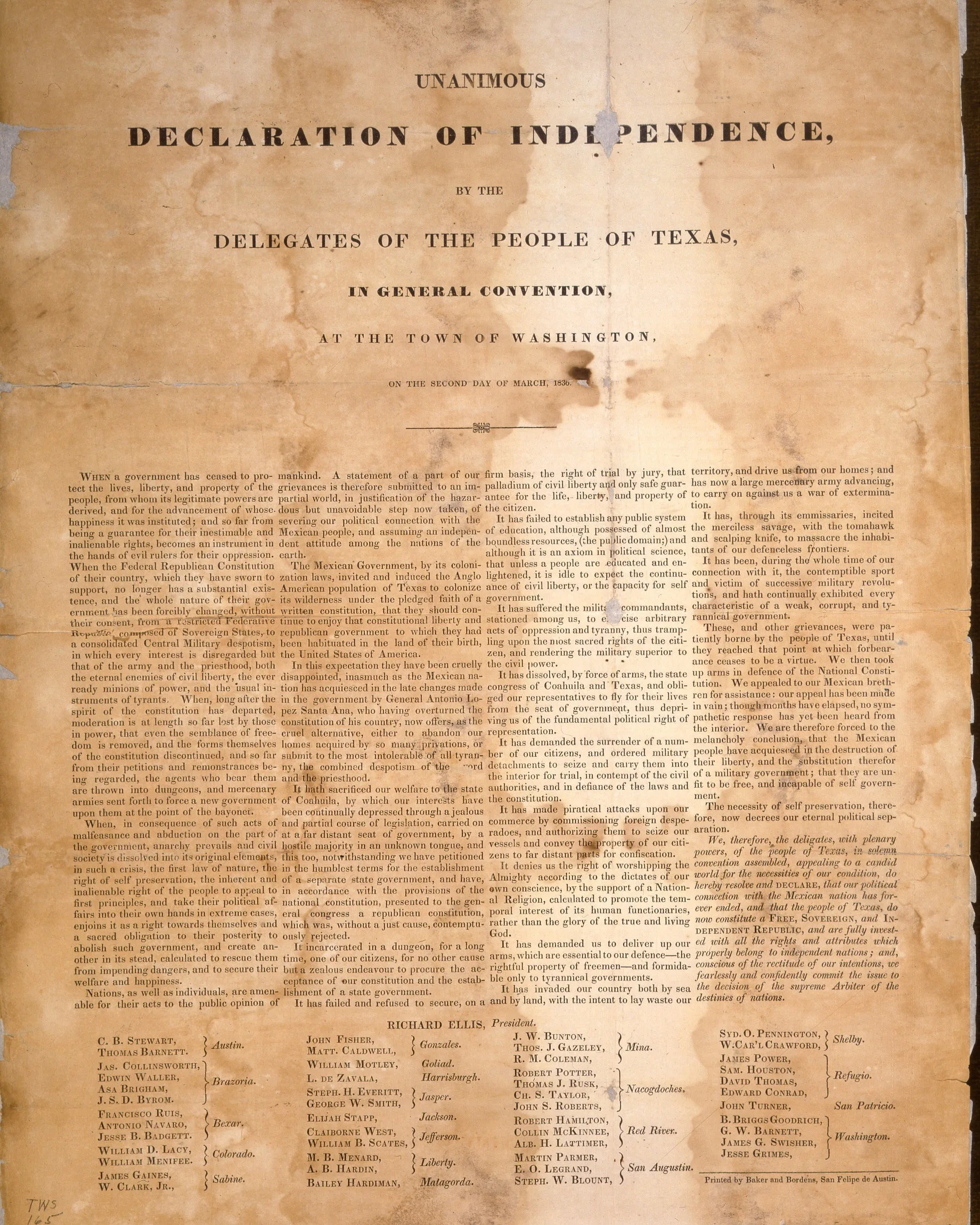
On March 2, 1836, the delegates of the people of Texas, meeting in convention at Washington-on-the-Brazos, adopted the Texas Declaration of Independence. The Handbook of Texas reports that George C. Childress, chairman of the drafting committee, is generally credited with writing it.
The Declaration speaks the language of nationhood directly. "Nations, as well as individuals," it begins its case, "are amenable for their acts to the public opinion of mankind." It announces that Texas is "assuming an independent attitude among the nations of the earth." Its closing resolution declares that "the people of Texas do now constitute a FREE, SOVEREIGN, and INDEPENDENT REPUBLIC," invested with the rights that "belong to independent nation."
The subject of that sentence is "the people of Texas." The convention did not create that people. It spoke for a people that already existed and was already acting together. Fifty-nine delegates attended. The Handbook lists their birthplaces. Most came from the American states. Three were natives of Mexico, two of them born in Texas. Others were born in England, Ireland, Scotland, or Canada. They signed as one body.
Two weeks later the same convention wrote the Constitution of the Republic of Texas. Its preamble begins "We, the people of Texas." It created a Congress and a presidency, and it required all prosecutions to run "in the name and by the authority" of the Republic. The Handbook records that the voters ratified it on the first Monday in September 1836.
Nearly a Decade as a Republic
The Republic was a working country. In the election of September 5, 1836, Sam Houston won the presidency with 5,119 votes. The government sat at Houston beginning in April 1837 and moved to Austin in October 1839. The Republic kept a navy; the Handbook describes a fleet of six vessels, with the sloop-of-war Austin as its flagship. Texas Rangers served on its frontier.
It also governed through foreign relations of its own. The United States recognized Texas independence in 1837, and France recognized it by treaty in 1839. The Republic made treaties with European powers and with the nations of the region. The companion essay, The Republic Among Nations, covers that record in full.
The Handbook estimates that the population grew by about 7,000 people a year during the Republic. Those newcomers joined a people with its own founding and its own government, and a history that no other people shared.
Symbols That Persist
A nation keeps its memory in its symbols. Texas has kept the Republic's symbols in force by law.
The flag. The Congress of the Republic passed the Lone Star Flag act, and President Mirabeau B. Lamar approved it on January 25, 1839. Today the Texas Government Code says: "The state flag is the 1839 national flag of the Republic of Texas." The official flag retirement ceremony written into that same chapter has the flag describe itself as "one of only two flags of an American state that has also served as the symbol of an independent nation."
The pledge. Texas law sets a pledge to the state flag: "Honor the Texas flag; I pledge allegiance to thee, Texas, one state under God, one and indivisible." The Education Code requires every public school district and open-enrollment charter school to have students recite it once each school day, along with the pledge to the United States flag. A parent may ask in writing that a child be excused.
The Declaration itself. The Handbook records that the signed original was deposited with the United States Department of State in Washington and was not returned to Texas until some time after June 1896. It was unveiled in a niche at the Texas Capitol on March 2, 1930.
The constitution. Article 1, Section 1 of the Texas Constitution of 1876, still in force, opens the Bill of Rights this way: "Texas is a free and independent State, subject only to the Constitution of the United States." Section 2 follows: "All political power is inherent in the people." It pledges the people of Texas to a republican form of government and states that, subject to that limit, they hold "the inalienable right to alter, reform or abolish their government in such manner as they may think expedient." Section 1 describes Texas as a state within the federal union. It also describes Texas as "free and independent," words that carry the memory of 1836 into the governing charter of today.
The Heritage Days
March 2 is Texas Independence Day, a state holiday under Section 662.003 of the Government Code. Section 662.048 makes it Texas Flag Day as well.
April 21 is San Jacinto Day, also a state holiday. On that day in 1836, Houston's army attacked the Mexican force at San Jacinto. The Handbook records that the battle "lasted but eighteen minutes." Santa Anna was captured there, and on May 14 he signed the Treaty of Velasco, agreeing to end hostilities and withdraw Mexican troops beyond the Rio Grande.
October 2 marks the Battle of Gonzales in 1835. Mexican dragoons came to take back a small cannon the settlers had been given for defense. The settlers refused, made a banner showing the cannon with the words "COME AND TAKE IT," and drove the dragoons off. The Handbook calls it a brief skirmish, and it records that the battle is regarded as the first shots of the Texas Revolution. October 2 is not a statutory holiday, but the state's own curriculum requires seventh graders in Texas public schools to study the battle.
Texan Identity Today
A nation keeps its memory by teaching it. Texas teaches its story by law. The state's social studies standards require Grade 7 students to study "the history of Texas from early times to the present." The standards name the Battle of Gonzales, the siege of the Alamo, William B. Travis's letter "To the People of Texas and All Americans in the World," the Convention of 1836, and the Battle of San Jacinto. They require students to study the administrations of Republic presidents Houston, Lamar, and Jones, along with the Texas Navy and the Texas Rangers.
Texans keep a national flag as their flag. They recite a pledge to it in every public school, every school day. Two of their state holidays mark the Declaration and the victory at San Jacinto. Their Bill of Rights opens by calling Texas free and independent. Their public schools teach their children the history of a people who declared themselves a nation and governed themselves as one.
What the Evidence Shows
Renan asked for a shared inheritance of memories and a present will to carry it forward. Texas has both. The memory is written in the Declaration and the Constitution of 1836 and in a Republic that governed itself for nearly a decade. The will is enacted in Texas law today, in the flag, the pledge, the holidays, and the curriculum, and renewed by every Texan who takes that history as their own. Measured against Montevideo, Texas meets every qualification of a state, and the land is a country by any account.
Texas was a nation before it was a state, and it is a nation now. What remains open is a decision about what Texas will do.
Sources
- Texas Nationalist Movement, The Twelve Principles
- Daniel Miller, "Nation, State, and Country" (2026)
- Ernest Renan, "Qu'est-ce qu'une nation?" (Sorbonne lecture, March 11, 1882), French text, Universite de Perpignan
- Avalon Project, Convention on Rights and Duties of States (Montevideo, December 26, 1933)
- TNM Education Library, Texas Declaration of Independence (March 2, 1836)
- TNM Education Library, Constitution of the Republic of Texas (1836)
- TNM Education Library, Constitution of the State of Texas (1876)
- Handbook of Texas, "Texas Declaration of Independence"
- Handbook of Texas, "Convention of 1836"
- Handbook of Texas, "Constitution of the Republic of Texas"
- Handbook of Texas, "Republic of Texas"
- Handbook of Texas, "Flags of Texas"
- Handbook of Texas, "Battle of Gonzales"
- Handbook of Texas, "Texas Revolution"
- Handbook of Texas, "Battle of San Jacinto"
- Texas Constitution, Article 1 (Bill of Rights)
- Texas Government Code, Chapter 662 (holidays and observances)
- Texas Government Code, Chapter 3100 (state flag)
- Texas Education Code, Section 25.082 (pledges of allegiance)
- Texas Education Agency, 19 TAC Chapter 113, Subchapter B (Grade 7 social studies)
Next in The Case of TexasThe Republic Among Nations