
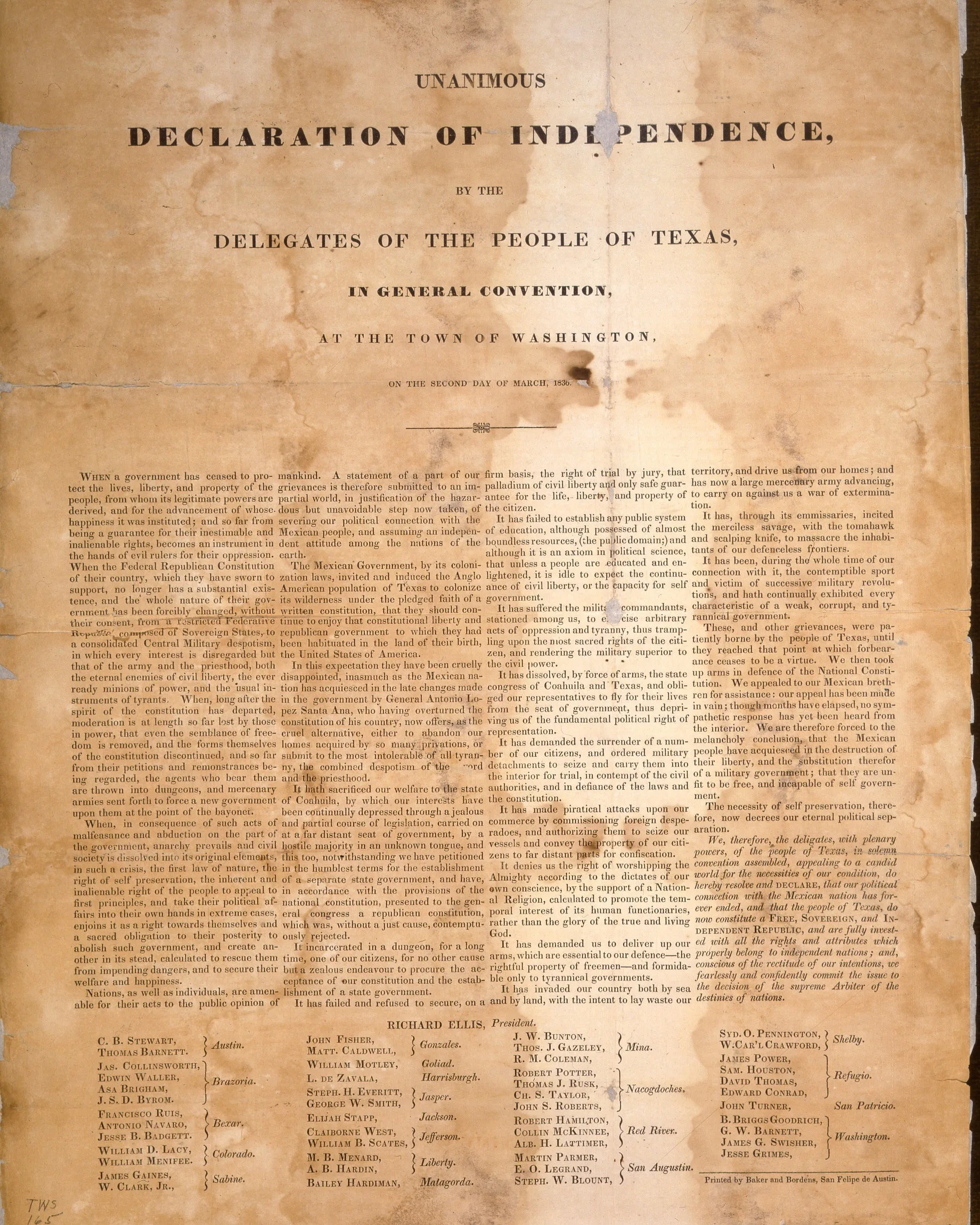
A Member of the Community of Nations
The Texas Declaration of Independence announced that Texas was "assuming an independent attitude among the nations of the earth." Declaring that standing was one step. Holding it was another. Between 1836 and 1845 the Republic of Texas did what independent countries do. It sought and won recognition, signed treaties, sent envoys abroad, and received foreign diplomats at home. The documents the Republic left behind record each step.
The Test of Statehood
International law later put the test of statehood into a single sentence. The Montevideo Convention of 1933 lists four qualifications: "a permanent population," "a defined territory," a government, and the "capacity to enter into relations with the other states." The convention came almost a century after the Republic, so it is a modern measure applied to an older case. The Republic meets it on each count.
It had a population. A U.S. State Department agent, Henry Morfit, estimated it in 1836 at 30,000 Anglo-Americans, 3,478 Tejanos, 14,200 American Indians, and 5,000 enslaved people. It had a territory, and in 1838 it agreed by treaty with the United States to survey and mark the border between them. It had a government under the Constitution of 1836. The fourth qualification, relations with other states, is the subject of the record below.
The convention adds a principle. "The political existence of the state," Article 3 reads, "is independent of recognition by the other states." Texas existed as a country before anyone recognized it. Recognition confirmed what was already true.
Recognition by the United States
Washington moved cautiously. Morfit advised delay, and President Andrew Jackson told Congress on December 21, 1836, that the United States had traditionally recognized a new community only when it could maintain its independence. The Handbook of Texas records that on March 1, 1837, Congress voted funds for "a diplomatic agent" to Texas.
The Office of the Historian at the U.S. Department of State dates recognition to March 3, 1837, when Jackson named Alcée La Branche to the post. It records that the Secretary of State accepted the credentials of William H. Wharton, the Texan minister, on March 6, 1837, and that La Branche presented his own credentials at Houston, then the seat of government, in late October 1837. The United States also kept consular posts in the Republic, at Matagorda and Velasco, among other places.
The two governments then made treaties. On April 11, 1838, at Houston, they signed a claims convention settling American claims over two vessels seized by the Texas Navy, the brigs Pocket and Durango. On April 25, 1838, at Washington, John Forsyth for the United States and Memucan Hunt for Texas signed a boundary convention to survey and mark the line between the two countries.
Recognition in Europe
France came first. The Treaty of Amity, Navigation and Commerce was signed at Paris on September 25, 1839, by James Pinckney Henderson for Texas and Marshal Soult for King Louis Philippe. Its preamble says the treaty shall "establish the formal recognition, on the part of France, of the Independence of the Republic of Texas." President Mirabeau B. Lamar proclaimed it on February 15, 1840.
The Netherlands followed. James Hamilton signed a treaty of amity, commerce and navigation at The Hague in September 1840. The Texas State Library and Archives dates the signed original September 18; the Handbook gives September 15. President Sam Houston proclaimed it on January 4, 1843.
Great Britain took longer. The Handbook records that Britain at first declined formal relations, wary of its standing with Mexico, though it admitted Texas commerce to British ports. Lamar then sent Hamilton to London with a letter of credence to seek recognition. In November 1840, Hamilton and Lord Palmerston signed three treaties. One governed commerce and navigation. The others provided for British mediation with Mexico and for suppression of the African slave trade. The State Archives records that Queen Victoria ratified them on May 26, 1842, and the Handbook records that ratifications were exchanged on July 28, 1842.
Britain recognized the Republic of Texas by treaty. Its government announced in 1840 that it would recognize Texas independence, as the State Archives and the Handbook both record. It then signed, ratified, and exchanged treaties with the Republic as one sovereign with another, and it accredited a chargé d'affaires, Charles Elliot, to the Texas government. Texas, for its part, kept a legation in London. A plaque placed by the Anglo-Texan Society in 1963 marks the building at 3 Pickering Place, off St. James's Street: "In this building was the legation for the ministers from the Republic of Texas to the Court of St. James, 1842 - 1845."
Not every effort succeeded. William Henry Daingerfield, the Texan chargé d'affaires to the Netherlands, negotiated a convention with the Hanseatic Republics of Lübeck, Bremen, and Hamburg, dated April 17, 1844. Bremen approved it. Hamburg and Lübeck did not, and the Handbook records that ratifications were never exchanged. Hamilton and his successors also failed to conclude a treaty with Belgium.
Treaties with the Nations of the Region
The Republic's treaty record began before its independence was secure. On February 23, 1836, commissioners Sam Houston and John Forbes signed a treaty with the Cherokee and associated bands. The Handbook records that the Senate of the Republic later rejected it, in December 1837.
After San Jacinto, President David G. Burnet and the captured Santa Anna signed the public Treaty of Velasco on May 14, 1836, ending hostilities. In a secret companion agreement, Santa Anna undertook to work for Mexico's recognition of Texas independence.
The library holds the Republic's later treaties with Indian nations: a treaty of peace with the Lipan dated January 8, 1838; the Treaty of Bird's Fort of September 29, 1843, with the Delaware, Chickasaw, Waco, Tawakoni, Caddo, Cherokee, and others; and the Treaty of Tehuacana Creek of October 9, 1844, with the Comanche and other nations, which President Anson Jones proclaimed on February 5, 1845.
Mexico itself moved last. The Handbook records that in late April 1845, Mexico agreed to recognize Texas independence, on condition that Texas not join any other country.
Diplomats and Legations
The Republic kept envoys abroad. Wharton, Hunt, Anson Jones, and Isaac Van Zandt served in Washington. Henderson went to Paris and London. Ashbel Smith later served as Texan envoy to both of those capitals. Daingerfield was chargé d'affaires to the Netherlands.
Foreign governments sent diplomats in return. La Branche served as the U.S. chargé d'affaires until he resigned on April 2, 1840. Charles Elliot served as British chargé d'affaires to Texas. France sent Alphonse Dubois de Saligny.
The Handbook describes the French Legation in two senses: Dubois de Saligny's diplomatic mission to Texas, which ran between 1840 and 1846, and the house in Austin built for him in late 1840 and early 1841 on land bought from Anson Jones. He held the rank of chargé d'affaires, not ambassador. His tenure was troubled, and he spent much of it away from Austin. France recalled the legation in May 1846, after annexation. The house still stands. The State of Texas bought it in 1948, and it opened as a museum in 1956.
Annexation by the Act of Two Governments
Texas first offered annexation in August 1837, and the United States declined. Texas withdrew the offer on October 2, 1838. A treaty of annexation was signed in April 1844, but the U.S. Senate rejected it in June 1844.
The method that succeeded was different. Congress passed the Joint Resolution for Annexing Texas, and President John Tyler signed it on March 1, 1845. The resolution did not annex Texas on its own authority. It consented that the territory of "the Republic of Texas" might become a state, with a constitution "adopted by the people of said republic, by deputies in Convention assembled, with the consent of the existing government." It set conditions Texas would have to accept, and it offered an alternative: negotiation between "the governments of Texas and the United States," by treaty or by articles.
The decision then passed to Texas. President Jones placed two choices before the Texas Congress and a convention of elected delegates: annexation, or independence recognized by Mexico. The convention met at Austin on July 4, 1845, and adopted the Ordinance of Annexation by a vote of fifty-five to one. Its operative words: "We, the Deputies of the people of Texas in Convention assembled, in their name and by their Authority, do ordain and declare, that we assent to and accept the proposals, conditions and guarantees" of the resolution.
The voters of Texas ratified the annexation agreement and a new state constitution in October 1845. Congress accepted that constitution, and Texas entered the Union on December 29, 1845. The Office of the Historian records that diplomatic relations between the Republic and the United States formally ended with the transfer ceremony on February 19, 1846.
What the Record Shows
Annexation was an agreement. One government offered terms. The other, the government of an independent republic recognized by the United States and by European powers, accepted them in the name of its people, after weighing an offer of recognition from Mexico. The Joint Resolution and the Ordinance both say so in their own words.
This is how a sovereign country joins a union: by its own consent, given through its own institutions. The treaties and the legations show Texas acting as a nation among nations. The manner of annexation confirms it.
Sources
- Office of the Historian, U.S. Department of State, "A Guide to the United States' History of Recognition, Diplomatic, and Consular Relations, by Country, since 1776: Texas"
- Avalon Project, Convention on Rights and Duties of States (Montevideo, December 26, 1933)
- Avalon Project, Joint Resolution for Annexing Texas to the United States (March 1, 1845)
- Avalon Project, Ordinance of Annexation (July 4, 1845)
- Texas State Library and Archives Commission, "Document Spotlight: Treaties of the Republic"
- Tarlton Law Library, University of Texas School of Law, treaty of commerce and navigation with Great Britain
- Handbook of Texas, "Diplomatic Relations of the Republic of Texas"
- Handbook of Texas, "Republic of Texas"
- Handbook of Texas, "French Legation"
- Handbook of Texas, "La Branche, Alcée Louis"
- Handbook of Texas, "Annexation"
- Handbook of Texas, "Convention of 1845"
- TNM Education Library, Treaty with France (September 25, 1839)
- TNM Education Library, Treaties with the United Kingdom (ratified May 26, 1842)
- London Remembers, Texas Legation plaque, 3 Pickering Place, London
- TNM Education Library, Treaty with the Kingdom of the Netherlands (September 18, 1840)
- TNM Education Library, Convention with the Hanseatic Republics (April 17, 1844)
Next in The Case of TexasThe Right to Alter, Reform or Abolish